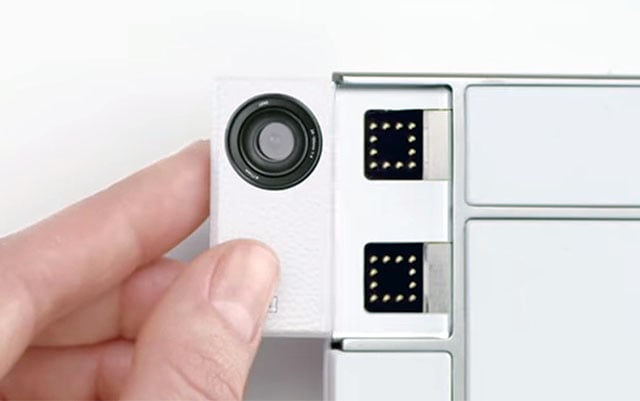
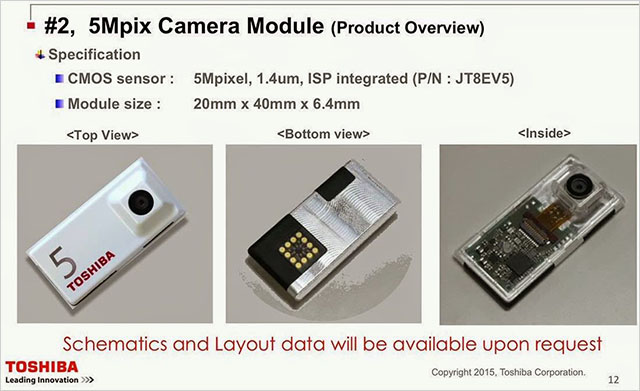
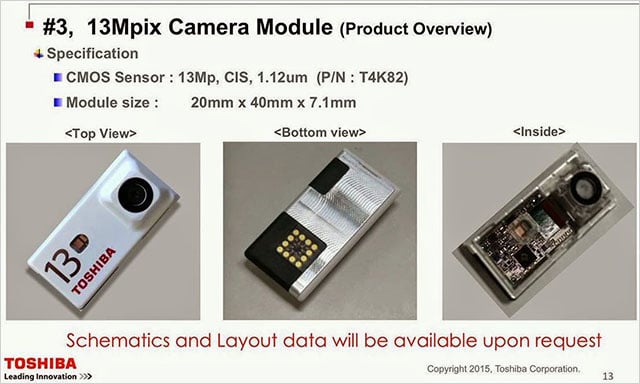
Google’s Project Ara will enable users to swap key components of its modular smartphone. Needless to say, the camera is also one of these swappable components. Toshiba is one of the companies that are working on swappable camera modules for Google’s Project Ara.
While Google continues its efforts to work on the modular smartphone, Toshiba has unveiled a few designs at Modular Phones Forum. From the looks of things, the three modules in the works include: 2-megapixel camera along with 5-megapixel/13-megapixel rear snappers. There’s no word on the cost yet.
The Google Ara smartphone will sport the camera component within a module that is easy to swap, meaning photographers can afford the luxury to enhance the quality of those snaps. All they require is an enhanced camera module to replace the one in use. It’s a bit like building yourself a new gaming PC.
The company emphasizes that the development plan has been divided in a total of three distinct stages. This, Basic phone function, is only the first phase of the lot, with the other two to follow and finish by sometime next year. The ones to follow have been termed, ‘Up-to-date features’ and ‘Unique module’.
A pilot test program of the modular smartphone is scheduled for launch later this year in Puerto Rico. Google is trying its utmost to make this as affordable as possible for all and sundry. That explains why it has been striving to reduce the “bill of materials (WiFi, CPU, frame, battery)” to a figure of $50.
LEGO doesn’t make phones, but if it did, it would probably make something very like Project Ara. Instead of buying a phone that’s obsolete within a matter of months, Ara proposes that you buy a modular design instead. When one part gets old or a better version appears, you’d just swap the old component for a new one. It sounds great, but will it work? Update: Phonebloks has given further details regarding how the Ara Module Marketplace will work. Plus news about the Ara Manager app, and the Project Ara Developer's conference which kicks off tomorrow. Head to the update section below for more details.
Update: Google is gearing up for a "market pilot" scheduled for later this year, where Project Ara will be made public (in some form or another) for the first time. Google has just released MDK 0.2, the second major iteration of its toolkit for third-party developers, which includes details on how best to create a module for Project Ara. It looks as if many companies are already on-board and will be discussing it tomorrow at the Project Ara Module Developers conference.
Additionally, the new MDK references an Ara Manager app, which will "allow users to get detailed information on all the modules currently attached to their device and swap them by commanding the [electro-permanent magnets] in the Endo to release." In layman's terms, this app will allow users to troubleshoot and configure the various modules they plug into their phones.
The Project Ara Module conference, which will be live streamed, promises more details of the product roadmap and the plans for the market pilot later in the year. Naturally we’ll be keeping a close eye on it to see what's discussed and will update this page with the latest info.
Phonebloks, the team behind Project Ara, has recently written a blog post which clarifies the workings of the Ara Module Marketplace, where the actual components will be bought on sold. It says the Ara Module Marketplace is:
an e-commerce portal that enables a two-sided market between module developers and consumers. Google will help module manufacturers with the sale, the payment processing and will verify that the modules are safe and that they respect all the technical specifications. A third party logistic provider will manage the storage, shipping and all trade issues.
If it works, it could provide a great space for both consumers and creators to interact. It has already been compared to the Google Play Store, and noted for its plans to include similar user reviews and recommendations.
The idea behind Project Ara is simple enough, although Google doesn’t do it any favors by describing it as “a development effort to create a modular hardware ecosystem”. It takes a smartphone and breaks it down into LEGO-style blocks, and those blocks are attached to each other and to a metal base plate using magnets. The base plate is shaped with block-sized slots to make assembly easier and to help reinforce the overall structure.
At the moment it’s for hardware and software developers, but the ultimate aim is to bring Ara to the next 5 billion people, the people who don’t currently have mobile internet access.
Project Ara price and release date
When does Project Ara come out and how much will it cost? Both answers are currently Google guesses: the hope is to have a limited pilot in 2015 with a manufacturing cost of $50 to $100 per device. That won’t necessarily be the street price, however: manufacturers have to make some money too.
Is Project Ara connected to the Nexus range or Google Silver?
No, it’s a completely separate project. Ara devices will run Android, but they won’t be Nexus- or Google-branded products.
Lack of built-in obsolescence is a major selling point here. If you’ve ever binned a perfectly good phone because you wanted better battery life, a better camera sensor or a better mobile data experience you’ll know that in many cases you’re sacrificing perfectly good components for the one or two extra features you want. With a Project Ara phone you’d be able to replace just the bits you want to replace. You wouldn’t even have to turn your phone off. It’d save you money, save the environment, make people find you even more sexually attractive… you get the idea. In the long term you might even be able to 3D-print the components to make a smartphone that’s completely and utterly unique.
Another key selling point is repairability. If something goes wrong with the innards of your smartphone it’s often new-device time; with an Ara device you’d just replace the broken bit and keep on computing. That helps cut down on unnecessary electronic waste too.
How did Project Ara get its name?
The project’s lead mechanical designer’s name is Ara. Just as well he isn’t called Sammy Crap-phone.
Project Ara all sounds too good to be true. Is Project Ara vaporware?
Maybe. Early coverage suggested that Ara could be as big a deal as Google Glass, but of course so far Google Glass hasn’t been that big a deal. The main areas of concern are weight and bulk - by its very nature an Ara device can’t possibly be as slim as today’s all-in-one smartphones - and whether the cost of buying multiple components means that an Ara phone would end up costing more than an off-the-shelf one, which would seriously ruin its sales. There are potential compatibility issues and performance concerns too. Remember the good old days of Windows PCs with their endless device driver problems and hardware conflicts? Exactly.
Project Ara has often been compared to the idea of building your own PC: instead of buying a device that isn’t quite perfect, if you go down the DIY route you can end up saving money and making a machine that fits your needs perfectly. That’s true, but if you look at the sales figures most people are perfectly happy with a good-looking laptop.
There will be a Project Ara Developer's conference on January 14th, 2015 where the plans for the rest of the year will be laid out. 2015 is also set to be the year that Project Ara is finally made public.
Should I be excited about Project Ara?
Cautiously, yes. If it delivers on its promises you could see the equivalent of the Google Play Store for smartphone hardware as well as apps. A phone that never becomes obsolete, that doesn’t require really expensive replacements every year or two and that can be repaired for pennies is a great idea, and the customization options are effectively limitless. If you want a device that’s truly your own, Ara promises to be the ultimate way of creating it.
That said, if Ara was Android we’d still be in the days of Android Astro Boy, Bender and R2-D2: a system with lots of potential that isn’t remotely ready for prime time. It arguably took Android four years to really hit its stride (with Ice Cream Sandwich, AKA Android 4.0), and getting the hardware equivalent right might take even longer. If Ara works it could revolutionize mobile computing. It just probably won’t do it in 2015.
What do you think of Project Ara? Are you looking forward to modular phones?